Departments need to complete new PIRs on time as well as managing the backlog
Post-implementation reviews (PIRs) are a legal obligation and a critical part of how government demonstrates that regulations are working as intended - or identifies when they are not.
The RPC has been monitoring departments' performance on undertaking PIRs and addressing the huge backlog of outstanding PIRs (those that have not been undertaken by the fifth anniversary of the introduction of the regulation) since the start of 2025.
Between our first PIR blog in April 2025, and our second PIR blog in December 2025, we saw an encouraging reduction in outstanding PIRs from over 80 to 47. It is disappointing that progress seems to have stalled as the number still stands at 47 today.
A full breakdown of all the PIRs outstanding by department is published on our website.
The stall is driven by new PIRs becoming overdue, together with limited progress being made on the previous backlog. PIRs are a practical way for departments to check for opportunities to reduce the burden of regulations on business. Departments should be aware, well in advance of the 5 year deadline, of their statutory obligation to complete all PIRs on time.
PIRs awaiting completion by department
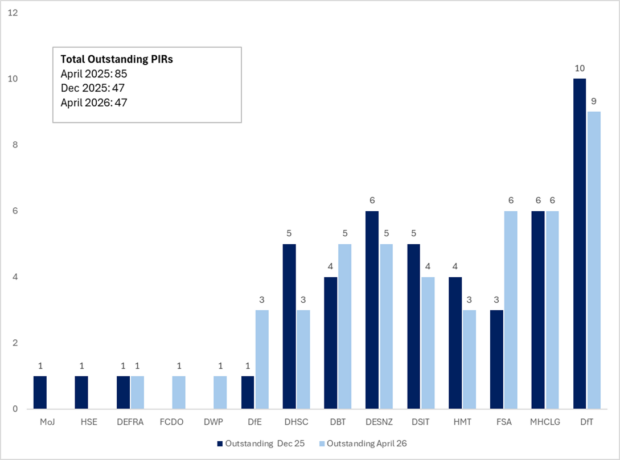
In December, I wrote again to the permanent secretaries of departments with the most outstanding PIRs asking them for renewed commitments to reduce their backlogs. The current performance against their commitments is set out below.
Strong performance
Ministry of Justice (MoJ) and Health and Safety Executive (HSE)
- We are pleased to report that both departments have cleared all of their outstanding PIRs.
Department for Environment, Food and Rural Affairs (DEFRA)
- DEFRA committed to completing their outstanding PIRs at the earliest opportunity - a commitment they delivered on, reducing their backlog from 10 to 1 in December. This was the strongest performance of any department in 2025.
- We are pleased to report that DEFRA has now drafted their one remaining PIR, which has completed RPC scrutiny and is now awaiting publication.
Progress made, but more to do
Department of Health and Social Care (DHSC)
- Last year, DHSC committed to completing their outstanding PIRs as soon as possible. DHSC now has 3 outstanding PIRs, down from 5 in December. While progress has been made, we expect DHSC to complete their remaining reviews without further delay.
Commitments missed - disappointing performance
Department for Transport (DfT)
- DfT committed to completing their outstanding PIRs by June 2025 - a deadline they missed. Following my letter in December, DfT's permanent secretary said that the department was taking steps to accelerate clearances but provided no specific completion date.
- DfT has 9 outstanding PIRs left. We expect them to give a firm date for completing these and to make significant progress by the time we next publish an update.
Department for Business and Trade (DBT)
- DBT committed to completing their outstanding PIRs by July 2025 - a deadline they missed. DBT's permanent secretary then committed to completing all remaining PIRs by April 2026.
- DBT now has 5 outstanding PIRs, with 4 of these having newly become overdue since our last report. We understand that these PIRs were delayed due to their dependence on other closely related workstreams and work to update the measures is now underway.
- We expect them to make significant progress on completing these by the time we next publish an update.
Department for Energy Security and Net Zero (DESNZ)
- DESNZ committed to completing their outstanding PIRs between summer and autumn 2025 - a deadline they missed. DESNZ's permanent secretary then committed to completing all remaining PIRs by April 2026 and then missed this commitment again.
- The department now has 5 outstanding PIRs, down from 6 in December, meaning just one review was completed. We understand that the remaining PIRs are in progress, with one currently with ministers for approval.
- We expect them to complete all outstanding PIRs by our next update.
Department for Science, Innovation and Technology (DSIT)
- DSIT committed to completing all outstanding PIRs by April 2026, a deadline they missed. One PIR is now published, a second was removed following the implementation of new legislation, and a new PIR was added, meaning DSIT currently has 4 outstanding PIRs.
- There are complexities associated with each of the outstanding PIRs as 2 are dependent on closely related workstreams with statutory requirements and the remaining 2, after some delay, are on track to be published in September 2026.
- We recognise DSIT’s positive steps since December and expect them to maintain momentum to eliminate the backlog entirely by our next update.
HM Treasury (HMT)
- HMT committed to completing their outstanding PIRs ‘in due course’ but still has 3 outstanding PIRs. One PIR has been drafted, which is currently under scrutiny by the RPC, and we expect a further one linked to this to follow soon.
- We expect them to give a firm date for completing their remaining outstanding PIRs and to make significant progress by the time we next publish an update.
Commitments still to be delivered
Ministry of Housing, Communities and Local Government (MHCLG)
- Last year, MHCLG provided no timescale for completing their outstanding PIRs. Following my letter to the permanent secretary, MHCLG committed to completing all their backlog by November 2026. MHCLG now has 6 outstanding PIRs, unchanged from December.
- The November 2026 deadline is the latest of any department's commitment and delivery against it will require sustained and urgent effort over the coming months. We will be monitoring progress closely and expect them to meet their commitment.
Why this matters
PIRs exist because regulations affect real people and real businesses. A regulation introduced 5 years ago was designed around the evidence available at the time. The world has changed, the business environment has changed and the policy objectives may have shifted.
Without a PIR, there is no systematic mechanism for identifying whether the regulation is still proportionate, still effective, or whether it could be simplified, amended or repealed to better serve its original purpose and to help meet new government objectives.
PIRs are one of the most practical ways departments can ensure that their regulations support the government's Growth Mission and help deliver the ambition to reduce administrative burdens by 25% in the Regulation Action Plan. This is harder to achieve if regulations aren’t checked for improvement importunities.
Next steps
If your department currently has overdue PIRs - or regulations approaching their review date in the next 12 months - now is the time to act.
The Department for Business and Trade will continue to collect PIR data from departments at 6 monthly intervals to monitor and we will report on progress.
The RPC secretariat is available to discuss your pipeline and answer questions about what a fit-for-purpose PIR looks like. Reach us at: enquiries@rpc.gov.uk.
Leave a comment