Since the new Better Regulation Framework was introduced in 2023, the Regulatory Policy Committee (RPC) has scrutinised over 120 options assessments and impact assessments (OAs and IAs).
This blog post explains what the data tells us about the quality of the evidence and analysis supporting regulatory policy proposals across government departments.
The headline figures
The overall message is encouraging – 95% of assessments received a Green (fit for purpose) rating after going through the RPC scrutiny process – with only 6 out of 122 IAs receiving a Red (not fit-for-purpose) rating.
However the detail below this headline is more concerning – only 70% of OAs/IAs were rated Green when they were first submitted to the RPC.
28% received an Initial Review Notice (IRN) indicating that we had concerns about the quality of the evidence and analysis, particularly around the rationale for a proposal and the identification of options. (The remaining 2% of OAs/IAs received a red rating without an IRN as the OA/IA was already published.)
How departments compare
There is a wide disparity between the quality of OAs and IAs submitted by different departments.
Proportion of Green rated OAs/IAs by department1
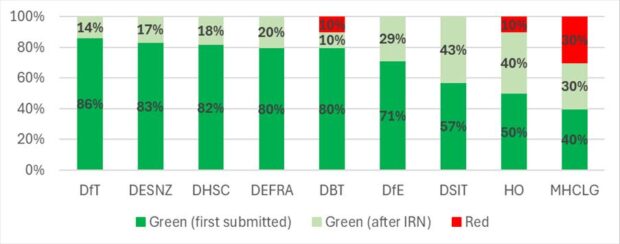
The data shows that the Home Office (HO) and the Ministry of Housing Communities and Local Government (MHCLG) were the worst performing departments with 50% and 60% respectively of their first submissions being not fit-for-purpose – we would like to see a substantial improvement in these numbers.
Even the best performing department (Department for Transport, DfT) had 1 in 7 of their submissions not fit-for-purpose as first submitted.
The graph also shows the improvement in quality arising from the RPC scrutiny process. All departments improved their scores significantly (with many getting 100% Green ratings) after revising their OA/IA to take account of the weaknesses and areas for improvement outlined in the IRN and resubmitting their OA/IA to the RPC for further scrutiny.
Beyond the Red/Green rating
There is also wide variation between departments in the quality of their regulatory scorecards and monitoring and evaluation plans.
These elements are rated:
- Good
- Satisfactory
- Weak or
- Very Weak
Weak and Very Weak ratings mean that the element "provides inadequate support for decision making". However they do not contribute to the overall Red/Green rating or the decision over whether an IRN is issued.
Proportion of Satisfactory/Good ratings by department2
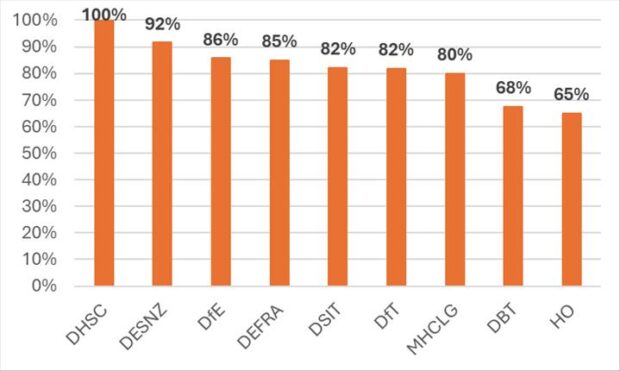
The best performing department was the Department of Health and Social Care (DHSC) who achieved good or satisfactory ratings across all of their regulatory scorecards and monitoring and evaluation plans, while the Department for Energy Security and Net Zero (DESNZ) was second with 92%.
At the other end of the table, the Home Office (HO) and Department for Business and Trade (DBT) were the weakest performers, with 35% and 32% of their ratings respectively being judged Weak or Very Weak. We would like to see substantial improvement in these numbers.
Across all 122 assessments, 84% of monitoring and evaluation plans and 80% of regulatory scorecards were rated good or satisfactory.
Next steps
We will continue to monitor and report on the quality of OAs and IAs.
Our earlier blog explaining the RPC’s rating system remains a useful starting point for any team preparing to send a submission.
Contact us at enquiries@rpc.gov.uk for informal advice and support from the RPC secretariat.
1 comment
Comment by James P posted on
I do hope there is a series of supporting measure being put in place for those departments who scored the lowest. Going in and having exploratory sessions, asking why they submitted and why they thought it was strong. What are their understandings etc. Then providing training. Not just power point but using officials from the best performing departments to show how their approach the submissions and what tools their use. Even shadowing could be done to up-skill.
This is an opportunity to build cross department support and improve productivity, by having most departments receive X% pass. Rather than publishing failures and leaving people to work it out without support.